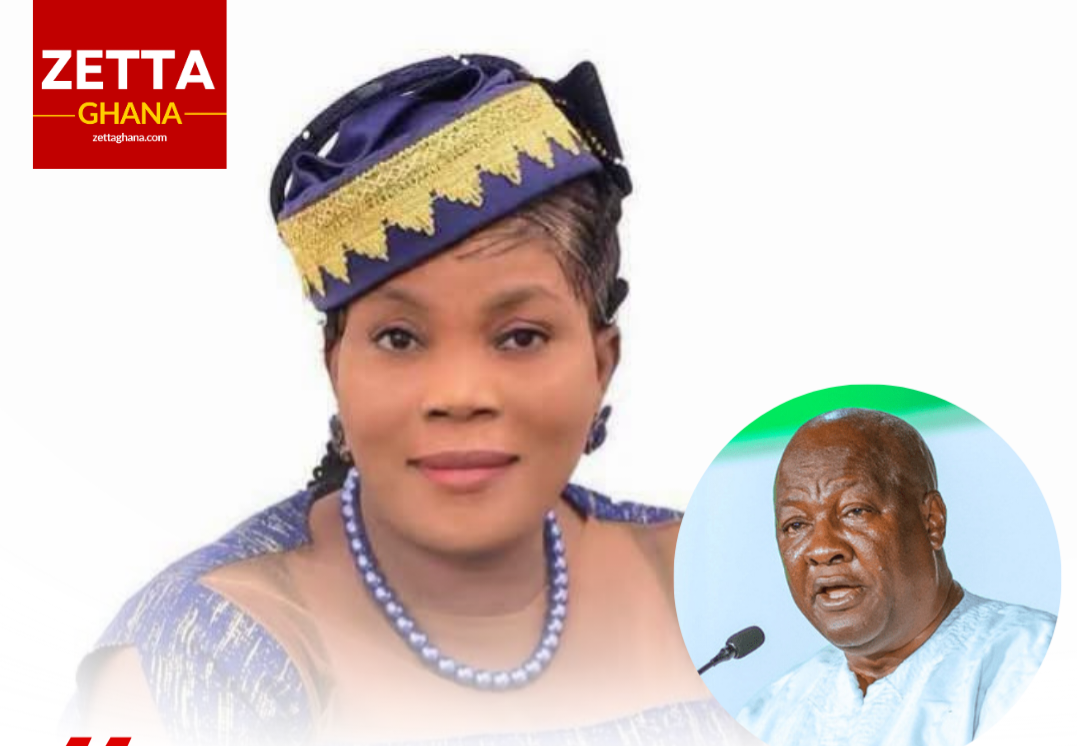
Founder and Leader of the People’s National Party (PNP), Janet Asana Nabla, has launched a scathing attack on President John Dramani Mahama, accusing him of lacking integrity over the appointment of a person she describes as an NDC spokesperson as Deputy Chairperson of the Electoral Commission (EC).
Nabla questioned the President’s credibility, arguing that his decision contradicts his previous criticism of the New Patriotic Party (NPP) over appointments to the Electoral Commission.
“The person leading this country is a liar and has no integrity,” she said, criticising the President over the appointment.
According to the PNP leader, President Mahama had previously criticised the NPP for appointing its own political associates to positions at the Electoral Commission, making his administration’s latest decision, in her view, inconsistent with that position.
She argued that the President was now doing what he had previously condemned, raising questions about his commitment to the principles he advocated while in opposition.
Nabla Questions Mahama’s Religious Values
Beyond the political controversy, Nabla also invoked President Mahama’s Christian faith, noting that he is a member of the Assemblies of God Church.
She argued that the President’s conduct was not only damaging his personal reputation but also reflecting negatively on the religious institution with which he is associated.
According to her, the President’s actions contradict the values he professes, accusing him of preaching virtue while practising the opposite.
Nabla maintained that the President’s public pronouncements and political decisions should be consistent, particularly when he has previously criticised other political parties for similar conduct.
EC Appointment Sparks Debate Over Political Neutrality
The controversy raises broader questions about political appointments to Ghana’s Electoral Commission and the importance of maintaining public confidence in the institution responsible for overseeing the country’s elections.
The Electoral Commission plays a critical role in Ghana’s democratic process, making perceptions of political neutrality and independence particularly important to public trust.
Nabla’s criticism centres on what she considers a contradiction between the President’s earlier position on appointments to the Commission and the decision taken under his administration.
However, her allegations represent her assessment of the appointment and the President’s conduct. The criticism does not, on its own, establish that the appointment violates any legal requirement or that the appointee is incapable of performing the role impartially.
The debate ultimately places renewed attention on the standards expected of political leaders and the need for consistency between their public statements and decisions while in office.